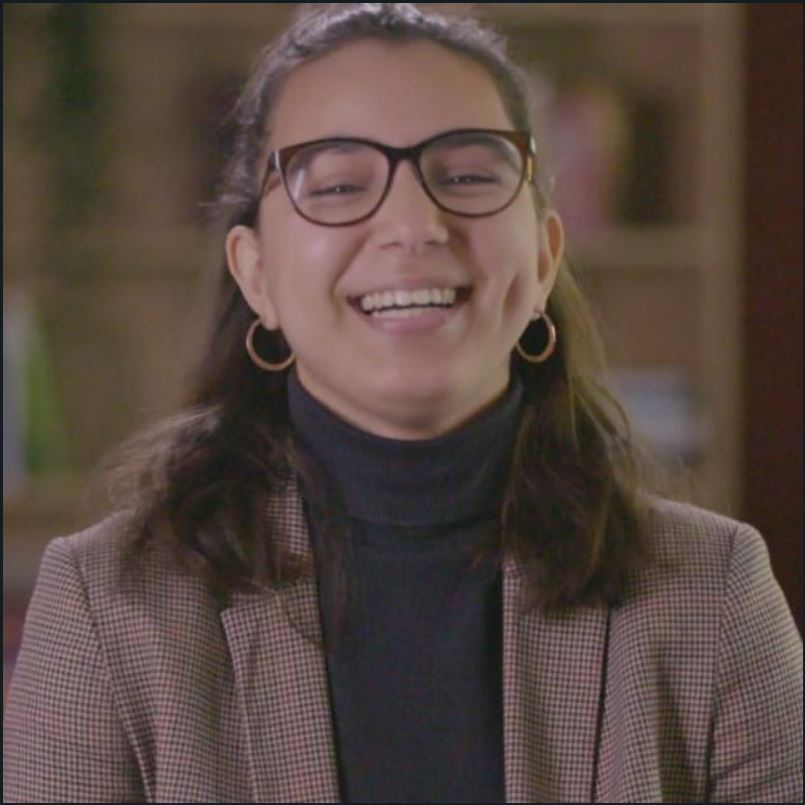
By Sara Said
History has never been just something I learned in school, it has always been something I lived. The more I reflect on both the past and the current state of the world, the more I realise that human nature has not changed as much as we like to claim.
We adapt our tools, our vocabulary, our institutions, but the deeper impulses e.g. fear of the unfamiliar, hunger for power, desire for belonging, remain stubbornly persistent. Growing up biracial in a world shaped by these enduring patterns has forced me to confront histories that intersect and collide within me. Being half Polish and half Egyptian, born and raised in Amsterdam, I have always existed at a crossroads, where geography meets culture, and where identities carry the weight of distant events that still shape the present.
Reflecting on this, I often question whether the systems around us were ever sound to begin with, or whether they were flawed from the moment they were conceived.
Growing up in Amsterdam meant growing up in a city known for its open-mindedness, diversity and global image of tolerance. And yet, beneath that reputation, I experienced the subtler layers of the Dutch social structure, a system that prides itself on equality while often ignoring the invisible hierarchies that persist. In classrooms, I was coded as ‘different’ before I even understood what that meant. In certain neighbourhoods, I felt the shift in atmosphere depending on which parent I was standing next to. Comments about my skin tone, my name or my roots came from people who believed they were being complimentary, not realizing how those remarks marked me as an outsider.
This feeling of being simultaneously inside and outside every space became even more complicated as I learned more about the histories connected to my identity. When the coursework explored the Transatlantic Slave Trade, I felt like I was learning not only about the past, but about the very architecture of racial thinking that still structures the world. Specifically the global economic system built on forced labor revealed how deeply race, and the power structures around it, had been engineered. It was not just the Americas that were shaped by this system, Europe, including the Netherlands, profited enormously from it. Walking the streets of Amsterdam after learning this history has felt different, because suddenly I could imagine the ships, echoes of auctions, and the wealth built on suffering that is rarely acknowledged out loud.
Yet my reflections did not stop at Europe. Being half Egyptian, I also had to confront another layer of history: the involvement of Arab groups in the enslavement of Africans on the continent. In school, the narrative often centered the Transatlantic Slave Trade, but as I dug deeper, I learned about the trans-Saharan and Red Sea slave trades, where African people were taken north and east into the Middle East and beyond. This was not a story I could distance myself from, it is woven into the history of the region my family comes from.
Realizing this complicated my understanding of oppression and identity. It reminded me that no group is purely victim or perpetrator, but that all histories are tangled, and that acknowledging these truths is necessary for understanding collective trauma and collective responsibility. It is all about perspective.
Holding these histories, European, African, Arab, within my own identity meant confronting uncomfortable realities. I could not claim one part of my heritage without recognizing the harm it may have contributed to, nor could I ignore the resilience and brilliance that emerged despite those harms. It forced me to question the simplicity of national pride or cultural belonging. Being Polish, Egyptian, and Dutch all at once meant being part of multiple stories, including ones that contradict or challenge each other.
It was Pan-Africanism that offered me a new framework for understanding my place within these intersecting legacies. Pan-Africanism emphasized unity, shared struggle, and the interconnectedness of African-descended people worldwide. Even though I am not fully African, the Egyptian part of my identity ties me to the continent, and the Polish part of me ties me to a Europe that cannot escape its own historical fingerprints. Pan-Africanism helped me understand that identity is not about purity, but about relationships, relations to past, present, and future. It reminded me that liberation cannot be limited by borders or bloodlines, and that solidarity is a political choice, not an inherited one.
Learning about the global nature of slavery, Europeans in the Atlantic, Arabs across North and East Africa, and other systems that existed before and after, deepened my understanding of how widespread the exploitation of African people was. And yet, African resistance, African culture, and African intellectual movements also spread widely. Pan-Africanism taught me that the descendants of these systems did not simply inherit pain, they inherited vision. W.E.B. Du Bois, one of the thinkers of the movement, emphasized collective empowerment, self-determination, and the reclamation of history from colonial narratives. That resonated with me because I, too, was in search of a way to reclaim a sense of belonging outside the narrow categories society tried to place me in.
The more I reflect on the current state of the world, the clearer it becomes that systems built centuries ago are still very much alive. They may no longer operate with chains and ships, but they persist through policies, stereotypes, inequalities, and cultural norms. In the Netherlands, racism often hides behind politeness, a subtle, coded form of exclusion that is easy to dismiss but impossible to ignore when you live it. Dutch society prides itself on progressiveness, yet conversations about race are often treated as unnecessary or divisive. My experience growing up biracial in Amsterdam taught me that being tolerated is not the same as being accepted, and being visible is not the same as being valued.
These experiences have shaped not only how I see the world, but how I see myself. I have learned to navigate identities that people try to simplify, and histories that refuse to be simple. I have learned that belonging is not something given, it is something claimed. And I have learned that understanding the past is not optional if we want to understand the present.
So when I ask whether the system was ever sound, the answer is complicated. Perhaps it was never designed to be sound for everyone. Perhaps inequality was not a flaw in the system but a feature. However, this does not mean it must stay that way. Human nature may not have changed, but our awareness can. Our choices can. Our solidarities can.
My identity, Polish, Egyptian, Dutch, exists at the intersection of histories of migration, oppression, resistance, and reinvention. It is at this intersection, I see both the fractures of the past and the possibilities of the future. The systems around me may still be unsteady, but I am learning to stand firmly within my own story, to acknowledge the histories I inherit, to challenge the injustices I witness, and to imagine something better than what has been.