
Author: Dr. Abu Tia Jambedu
Institution: Millar Institute for Transdisciplinary and Development Studies (MITDS/MOU).
- O BOX 607, Bolgatanga Upper East Region Ghana
Department: Culture and Development Studies
Contact Details: Mobil: +233208016572
Email: jambeduabu@gmail.com
ORCID: [Insert ORCID if available]
- Paster (PhD)
Institution: Millar Institute for Transdisciplinary and Development Studies (MITDS/MOU).
- O BOX 607, Bolgatanga Upper East Region Ghana
Department: Culture and Development Studies
Abstract
This study introduces the Cosmic System Constellations of Cosmovision in Ancestorcentrism (CSCCA) as a transdisciplinary framework for quantifying Indigenous Knowledge Systems (IKS) among the Mossi-Dagbamba across Ghana, Togo, and Burkina Faso. Anchored in African philosophy and guided by a mixed-method exploratory sequential design, the research engaged 96 participants for the study. Participants represented six generational cohorts: Silent Generation (80–97 years), Baby Boomers, Generation X, Millennials, Generation Z, and Generation Alpha. These categories were critical in mapping the flow, transformation, retention, and decline of Indigenous Knowledge across generations. Findings revealed a regional gradient of knowledge retention—Burkina Faso (70%), Togo (60%), and Ghana (50%)—with older generations (aged 60+) demonstrating near-perfect interpretive competence (85–100%). High IKS fluency correlated with preference for herbal medicine, while knowledge loss was linked to biomedical dependence and language attrition. Unlike Millar’s earlier Ancestorcentrism frameworks, which remained largely conceptual or ethnographic, and classical statistical models, the CSCCA model addresses models limitations by integrating spiritual, metaphysical dimensions and culturally grounded cosmologies and worldviews in their ancestral authority and ritual logic. It introduces a quantifiable, culturally grounded analysis and logic capable of visualising and measuring Ancestorcentrism and IK flows across generations and geopolitical borders. This study’s key contribution lies in reframing Ancestorcentrism not only as a cultural worldview and development philosophy but also as a diagnostic tool. The CSCCA model offers an innovative, replicable framework for evaluating IKS, contributing uniquely to African epistemology and global transdisciplinary research.
- Introduction
In recent decades, global scholarship has increasingly recognised that human existence cannot be adequately understood through reductionist science and quantitative empiricism alone. Pioneering transdisciplinary thinkers (Piaget, 1972; Nicolescu, 2005, 2019) highlight that integrating scientific, ethical, cultural and spiritual knowledge systems is essential for responding to global complexity. This approach responds to contemporary global crises such as climate change, social inequality, and environmental degradation by emphasising holistic and participatory ways of knowing (McGregor & Gibbs, 2020; Werlen, 2015). Scholars like Gibbs (2017) and Lynch et al. (2021) further highlight the emancipatory power of transdisciplinary science to unify diverse epistemologies into systems that reflect the totality of human experience.
Despite these advances, existing transdisciplinary and Indigenous Knowledge scholarship remains predominantly descriptive rather than empirical. Few studies have developed robust tools for measuring Indigenous Knowledge Systems (IKS) across generations, regions, or cosmological dimensions. This limitation is particularly evident in West Africa, where ancestral worldviews are rich but lack systematic quantification.
However, despite the advancement of transdisciplinary theory, dominant research frameworks continue to privilege Western rationalism as the primary lens for validating knowledge and progress (Falola, 2022). This intellectual hegemony marginalises Indigenous epistemologies that are relational, spiritual, and communally embedded—forms of knowledge that have long guided sustainable living and social cohesion across non-Western societies. Thus, there is a growing recognition that global science must expand its ontological and epistemic frontiers to include non-Western systems of thought, particularly those rooted in ancestral cosmologies and holistic worldviews (Iaccarino, 2003; Mazzocchi, 2006).
In Africa, transdisciplinarity is not a novel import but a deeply embedded indigenous tradition. African societies have historically viewed the world through cosmovision—a holistic worldview linking the physical, spiritual, and moral realms into a unified system of existence (Rousseau & Billingham, 2018). Within this framework, Culture and Art serve as expressive vessels of identity and meaning; Philosophy provides ethical reflection and metaphysical grounding; and Science, Technology, and Innovation transform cultural and philosophical insights into tangible action. This interconnected worldview has long shaped African approaches to governance, ecology, and wellbeing (Millar, 1999; Iaccarino, 2003).
Contemporary scholars reaffirm this trans-level epistemology. Mekoa (2019) describes ancestors as moral guardians and keepers of wisdom; van Rooyen (2018) and Göcke (2018) locate transcendence and spirituality within African metaphysics; and Giri (2021) emphasises ancestral consciousness as a process of intellectual and spiritual border-crossing. These perspectives align with the African ontological principle of relationality, where being is inseparable from community, nature, and the ancestral continuum (Ekeh, 2020). In this sense, Africa’s knowledge heritage embodies transdisciplinarity in practice—integrating metaphysics, ethics, and empirical observation in ways that modern science only now seeks to rediscover.
Drawing from this philosophical heritage, Millar (1999, 2006, 2008) developed Ancestorcentrism and Endogenous Development as complementary paradigms that position ancestral consciousness at the heart of knowledge production and sustainable transformation. These frameworks argue that development must begin from within—anchored in cultural ethics, spiritual balance, and ecological harmony. Jambedu (2024) advances this lineage through the Cosmic System Constellations of Cosmovision in Ancestorcentrism (CSCCA), a meta-framework that quantifies Indigenous Knowledge Systems (IKS) by integrating culture, philosophy, and science.
The CSCCA unites the What (Culture and Art), Why (Philosophy and Spirituality), and How (Science and Technology) as interconnected constellations of reality. It provides a methodological tool for mapping and measuring Indigenous knowledge retention, transmission, and transformation across generations. In doing so, it transcends the divide between narrative wisdom and empirical data, affirming that Indigenous epistemologies are not pre-scientific but dynamically quantifiable systems of logic and observation (Millar & Derbile, 2018; McGregor, 2018).
Despite the philosophical richness of African transdisciplinary thought, a major gap persists in its empirical operationalisation. Earlier frameworks—such as Millar’s Ancestorcentrism and Endogenous Development and Santuah’s (2020) regional adaptations—conceptualised African knowledge as holistic and transformative but lacked a validated measurement model. Likewise, global transdisciplinary schools (Mokiy & Lukyanova, 2021; Lynch et al., 2021) seldom incorporate the metaphysical and ancestral dimensions central to African epistemologies. Consequently, few studies have quantitatively assessed how Indigenous Knowledge Systems evolve, decline, or adapt across generations and cultural boundaries.
This gap is particularly visible among the Mossi-Dagbamba of Ghana, Togo, and Burkina Faso, whose shared ancestry and oral traditions represent one of West Africa’s most enduring transboundary knowledge systems. Yet, no prior study has systematically measured IKS retention, intergenerational transmission, and cultural preference within this group through a transdisciplinary, quantifiable lens.
No existing framework integrates ancestral cosmology, African metaphysics, and quantitative analysis into a single diagnostic tool. Furthermore, no previous study has:
- empirically operationalised Ancestorcentrism,
- measured Indigenous Knowledge across six generations, or
- conducted transnational comparison across Ghana, Togo, and Burkina Faso.
This study addresses these gaps by validating the CSCCA framework as both a philosophy and a measurable Indigenous Knowledge model.
The overarching objective of this research is to operationalise and empirically validate the Cosmic System Constellations of Cosmovision in Ancestorcentrism (CSCCA) as a measurable and diagnostic model for Indigenous Knowledge Systems (IKS) among the Mossi-Dagbamba across Ghana, Togo, and Burkina Faso.
The study is justified on three interrelated grounds:
- Theoretical Justification: It bridges the divide between African Indigenous epistemology and global transdisciplinary science by providing a culturally grounded quantification development model that validates IKS within its own logic of being.
- Empirical Justification: It fills the methodological gap by applying a mixed-method, cross-generational, and cross-border approach to measure Ancestorcentrism and IKS retention, interpretation, and intergenerational transformation.
- Developmental Justification: It contributes to the decolonisation of IK production, Science, Technology, Innovation and advances Endogenous Development (Millar, 2014) by demonstrating that Africa’s ancestral wisdom is both a living philosophy and a practical science for sustainable wellbeing.
From the literature, the study anticipates generational decline, regional variation in IKS retention, and strong relationships between spiritual interpretation, herbal knowledge, and ecological memory. These theoretical insights provide the empirical expectations that guide the methodological and analytical design of the study.
Ultimately, this study asserts that Indigenous knowledge is not static tradition but dynamic science—capable of informing modern development through transdisciplinary inquiry and ancestral logic.
CHAPTER TWO
2.1 THEORETICAL AND CONCEPTUAL FRAMEWORK
Global scholarship on transdisciplinarity converges on the need to transcend fragmented disciplinary thinking in order to address complex real-world problems (Max-Neef, 2005; Nicolescu, 2002, 2005, 2019). Nicolescu’s transdisciplinarity is foundational, emphasising multiple levels of reality, the logic of the included middle, and a mediating “zone of non-resistance” where different knowledge forms co-exist without domination (Nicolescu, 2002, 2005). Max-Neef (2005) strengthens this claim by insisting that no knowledge system is complete and that values, ethics and lived experience form part of scientific inquiry. Krause’s metaphysics—articulated through Göcke (2018)—adds a deeper philosophical justification, proposing a both/and metaphysical stance of immanence and transcendence. Systems theorists such as Mokiy (2010, 2019) and Mokiy and Lukyanova (2017, 2021, 2022) conceptualise transdisciplinarity as a comprehensive systems-integration approach, while McGregor (2018, 2020), McGregor and Donnelly (2014), and McGregor and Gibbs (2020) introduce “transdisciplinary generalism,” embedding transdisciplinarity within professional action and methodological practice. Lynch et al. (2021) further describe generalism as navigating uncertainty and complexity across knowledge domains.
However, these global formulations reveal several gaps. First, they rarely engage concrete Indigenous cosmologies or worldviews (Agrawal, 1995; Battiste, 2000). Second, although Krause’s metaphysics provides a bridge, global TD does not integrate African ancestral metaphysics or relational ontologies (Göcke, 2018; Mbiti, 1990). Third, there is a limited effort to measure Indigenous epistemologies such as interpretation competence or knowledge retention (Sillitoe, 2007; Mazzocchi, 2006). Fourth, global TD lacks attention to genealogy, ancestral time and multi-generational transmission, which are central to African metaphysics (Muhamba et al., 2023; Ekore & Lanre-Abass, 2016a, 2016b). Finally, global TD does not present a development paradigm grounded explicitly in African worldview traditions (Odora Hoppers, 2002, 2020; Hountondji, 2017).
African scholars fill these gaps by grounding transdisciplinarity in lived cosmology. Millar (1999, 2006, 2008, 2014) conceptualises the African cosmos as an interwoven social–spiritual–material constellation guided by ancestral presence. Ancestorcentrism positions ancestors as epistemic agents influencing ethics, knowledge and decision-making (Millar, 2006; Jambedu, 2020), while Endogenous Development emerges from local cosmological logic rather than external prescriptions (Millar & Derbile, 2018). African philosophers affirm relational ontology and layered temporality (Ekeh, 2020; Ramose, 2002), while Giri (2021) and van Rooyen (2018) emphasise continuing relevance of transcendence and immanence in African spiritual experience. Methodologically, African research requires engaging genealogies, rituals, songs, proverbs and oral histories as legitimate scientific forms (Groh, 2018; Warren et al., 1995).
The CSCCA framework operationalises this African worldview into a formal transdisciplinary model. Rooted in Ancestorcentrism (Millar, 2006; Jambedu et al., 2024), CSCCA structures knowledge into three domains—the What (culture and lived experience), Why (spiritual–metaphysical philosophy) and How (science, technology and innovation)—and four intersections generating logic, ontology, relational realism and holistic quiddity. It further embeds two trans-levels: ancestral mediation (U₁) and the wider knowledge community (U₂). By translating African cosmovision into measurable analytical tools—interpretation indices, generational comparisons and regional gradients—CSCCA provides a rigorous African transdisciplinary framework that resolves the major gaps in global TD thinking.
2.2 Summary and Theoretical Contribution.
This section has traced a coherent intellectual progression: beginning with global movements toward the recognition of Indigenous Knowledge, moving into Africa’s ongoing epistemic renaissance, and culminating in the development of the Cosmic System Constellations of Cosmovision in Ancestorcentrism (CSCCA) as a grounded, empirically tested framework for studying Indigenous Knowledge Systems across Ghana, Togo, and Burkina Faso.
The analysis demonstrated that Ancestorcentrism is not merely a cultural philosophy but a scientifically operationalisable framework. By integrating ancestral wisdom, metaphysical logic, and transdisciplinary science, the CSCCA model transforms Indigenous epistemologies into systems that are both interpretive and measurable. It therefore provides a conceptual and analytic foundation for cultural sustainability, ethical leadership, and endogenous development in Africa.
The table below summarises how this study directly responds to key gaps in existing literature. Each gap identified by earlier scholars (e.g., Millar, Odora Hoppers, Dei, McGregor) is matched by a corresponding contribution of the CSCCA framework. This shows clearly how the model advances African Indigenous Knowledge scholarship in scope, methodology, theory, and empirical validation.
Ancestorcentrism & CSCCA Framework: Summary of Theoretical Contributions
| Type of Gap | Gap in Existing Literature (Millar et al.) | Your Contribution (via CSCCA & Ancestorcentrism) |
| 1. Evidence Gap | Limited to Dagara and Grunshe groups; no transnational data | Extended the scope to the trans-border Mossi–Dagbamba across Ghana, Togo, and Burkina Faso, generating empirical and generational datasets. |
| 2. Knowledge Gap | Did not explore ancestral spirit in epistemic validation and axiological balance. | Introduced the Ancestral Spirit as a mediator and sacred proof IK, moral order, and development balance. |
| 3. Practical-Knowledge Conflict Gap | No practical framework to quantify Indigenous Knowledge Systems. | Developed the CSCCA framework—a transdisciplinary and quantifiable model of IKS and intergenerational knowledge flow. |
| 4. Methodological Gap | Lacked a robust system for analyzing quantitative data on IKS. | Designed and tested a mixed-method model that integrates qualitative tools (TGT, CAD, SRP) with quantitative indices of knowledge retention. |
| 5. Empirical Gap | No cross-country or generational measurement tools. | Introduced empirical testing of interpretive competence across six generations in three countries. |
| 6. Theoretical Gap | Conceptual foundation lacked clarity in transdisciplinary applicability. | Positioned Ancestorcentrism within transdisciplinary philosophy, using systems thinking, metaphysical logic, and indigenous epistemology. |
| 7. Population Gap | Narrow scope (only two ethnic groups in Ghana). | Expanded the research to include the Mossi–Dagbamba trans-border identity, enhancing cultural and academic relevance for West African studies |
The CSCCA is thus not only a theoretical lens but an operational model of cultural, scientific, and ethical development from an African ontological perspective
Integrated Interpretation
The synthesis of these gaps and contributions demonstrates that the CSCCA is more than a theoretical lens. It is a fully operational model that connects culture, spirituality, philosophy, and science to produce an African-centred framework for knowledge production and development. By addressing evidence, methodological, theoretical, and empirical limitations in existing literature, the CSCCA advances the study of IKS from descriptive ethnography into a measurable, comparative, and generationally grounded system of knowledge analysis.
In doing so, this study makes a significant contribution to Indigenous Knowledge scholarship and provides a foundational model for future transdisciplinary research, policy formulation, and endogenous development programming in Africa.
3.0 Methodology.
This study employed a mixed-method exploratory sequential design to investigate Ancestorcentrism and Indigenous Knowledge Systems (IKS) among the Mossi–Dagbamba communities of Ghana, Togo, and Burkina Faso. Mixed-method designs are particularly suited for culturally embedded research because they permit the integration of qualitative depth with quantitative validation (Creswell & Plano Clark, 2018). Fieldwork was conducted across six regions—Nord and Yatenga Provinces (Burkina Faso), Dapaongo and Tanjore Districts (Togo), and the Northern and North-East Regions of Ghana—enabling a multi-country comparison of intergenerational knowledge transmission.
The philosophical underpinning of the study was rooted in transdisciplinarity and phenomenology, which allow for the exploration of knowledge as lived, embodied, and cosmological experience (Nicolescu, 2010; van Manen, 2016). This orientation aligns with African Indigenous epistemologies, which emphasise interconnectedness between the physical, spiritual, cultural, and ecological worlds (Odora Hoppers, 2002; Dei, 2018). The methodology integrated case study inquiry, ethnomusicology, narrative traditions, and participatory visual tools such as the Three-Generational Tree (TGT) and Dynamic Posters and Mind Mapping (DPMP)—well-recognized techniques in decolonial and community-centred research (Smith, 2012; Chilisa, 2019).
A transdisciplinary ethnographic design guided the research process. Qualitative techniques—including Storytelling, Riddles and Proverbs (SRP), Conversational Analysis (CA), Chanting and Incantations (CIs), Songs, Poems and Recitals (SPRs), Dirge and Praise Singing/Appellations (DSPSA), Critical Arena Discussions (CADs), and Focus Group Discussions (FGDs)—were selected for their cultural appropriateness and their ability to surface deep ancestral knowledge and oral cosmologies (Millar, 1999; McGregor, 2004). Key Informant Interviews (KIIs), Imageries/Artefacts/Relicts (IAR), and Historical Sites and Auspicious Moments (HSAM) further enriched genealogical and historical reconstruction. TGT and DPMP served as the central participatory visual tools for mapping lineages, tracing cultural memory, and facilitating communal analysis within the CSCCA (Cosmic System Constellations of Cosmovision in Ancestorcentrism) framework.
A total of 96 participants were selected using purposive and snowball sampling, consistent with Indigenous and community-based research protocols that prioritise knowledge custodians and lived experts (Chilisa, 2019; Kovach, 2009). Participants represented six generational cohorts—Silent Generation, Baby Boomers, Generation X, Millennials, Generation Z, and Generation Alpha—allowing the study to analyse patterns of intergenerational IKS transmission and decline. Ethical approval was secured from the Millar Institute for Transdisciplinary Studies Ethics Review Board, and all participants provided informed consent.
For the quantitative phase, Likert-scale instruments (1–5) were developed to assess IKS competence, spiritual interpretation, medicinal memory, and healing preferences. Quantitative data from 30 participants were analysed using SPSS, employing non-parametric descriptive statistics and visual graphs, which are appropriate for small-sample Indigenous research contexts (Bryman, 2016). These analyses supported the empirical testing of the CSCCA model and generated insights into generational shifts in knowledge retention.
Interpretive competence was used as a proxy indicator because it reflects the ability to decode ancestral symbols, genealogies, proverbs, rituals, and ecological knowledge—an approach supported by IKS scholars (Warren et al., 1995; Sillitoe, 2007; McGregor, 2004).
Qualitative data were transcribed, translated, and analysed using NVivo, applying thematic, narrative, and discourse analysis (Bazeley & Jackson, 2013). Genealogical information generated through TGTs was triangulated with oral histories, symbolic interpretations, and material cultural evidence (IAR/HSAM) to ensure cultural validity and epistemic coherence—an approach consistent with Indigenous methodologies that treat knowledge as multidimensional and relational (Wilson, 2008; Dei, 2018).
Overall, the methodological architecture provided a rigorous, culturally grounded, and empirically triangulated approach for understanding Ancestorcentrism as both a philosophical system and a measurable Indigenous Knowledge framework across three West African countries.
Chapter 4: Findings and Discussion
4.1 Introduction
This chapter presents and discusses the empirical findings from the application of the CSCCA (Cosmic System Constellations of Cosmovision in Ancestorcentrism) framework across three West African countries: Ghana, Togo, and Burkina Faso. Drawing from 96 participants across six generational cohorts, and triangulating qualitative insights with quantitative validation, this chapter critically interprets how Indigenous Knowledge Systems (IKS) are retained, diluted, or transformed over time. The discussion is guided by a transdisciplinary lens and substantiated with relevant literature.
The findings are organised to reflect the three CSCCA domains, “The What, The Why, and The How”. They begin with genealogical reconstructions (What), proceed to spiritual and interpretive competence (Why), and conclude with Indigenous science, healing preferences, and ecological memory (How).
The What that represent Generational analysis is particularly important in Indigenous Knowledge research because it reveals how cultural memory and wisdom, ancestral consciousness, and interpretive competence shift across age cohorts.
4.2 Tracing Intergenerational Links, Governance and Ancestral Continuity through the TGT and DPMP in Ancestorcentrism
The investigation revealed that the Three-Generational Tree (TGT) and Dynamic Posters and Mind Mapping (DPMP) served as the central Indigenous tools for tracing the genealogical lineages, kinship structures, and governance systems of the Mole–Dagbamba people across Ghana, Togo, and Burkina Faso. These tools offered a clear visual roadmap of ancestral succession, clan relationships, and political legitimacy, allowing communities to reconstruct their collective memory with precision.
Field engagement began with Life Histories and Narratives (LH/N), which naturally opened pathways into deeper generational memory. As respondents narrated their histories, DPMP enabled the drawing of genealogical mind maps, while TGT helped structure these narratives into clear generational layers—grandparents, parents, and children. These visual tools were especially effective in mapping royal descent, clan differentiation, and ancestral connections that underpin political authority in Mole–Dagbamba society.
Participants navigated fluidly across multiple Indigenous analytical techniques—
- SRP (Storytelling, Riddles, Proverbs) to recall lineage origins;
- CA (Conversational Analysis) to interpret relationships and ancestral roles;
- CIs (Chanting and Incantations) and SPRs (Songs, Poems, Recitals) to invoke ancestral names and ritual histories;
- DSPSA (Dirge Singers, Praise Singers, Appellations) to authenticate genealogical claims through praise poetry and clan appellations;
- KIIs and FGDs to verify histories across generations;
- IAR (Imageries, Artefacts, Relicts) in Nalerigu (Ghana) and HSAM (Historical Sites and Auspicious Moments) in Tanjoure (Togo) to physically trace ancestral shrines and royal burial grounds;
- CADs (Critical Arena Discussions) to debate conflicting historical narratives and resolve discrepancies in genealogical accounts.
Although each tool provided a unique epistemic pathway, together they converted into three broader Cosmic System Constellations, producing five Structures of Reality and nine Cosmovisions—the full philosophical–spiritual worldview of the Mole–Dagbamba.
The genealogical trees generated through TGT and DPMP closely aligned with established historical diagrams in Figure 1 (Genealogical Tree of the Mole–Dagbamba Kingdom) and Figure 2 (Kings of Mamprugu in Order of Succession). This convergence confirms that the visual reconstructions produced through Indigenous methods are accurate, reliable, and consistent with earlier scholarly records (Iddi Wuni, 2004; Gbanwaah, 2008; Abubakari, 2016).
Findings from IAR in Yendi (09/11/2023) and HSAM in Tanjoure (10/12/2023) further revealed that genealogy forms the backbone of Mole–Dagbamba governance. A KII with an elder in Zitenga, Burkina Faso (10/11/2023) captured this enduring philosophy:
“We live because they live in us; when we call their names, they answer—and our history answers.”
Through DSPSA sessions in Wungu, Ghana (11/11/2023), it became clear that praise singers and dirge performers serve as living repositories of political succession, lineage memory, and ancestral accountability. Their oral recitations maintain governance transparency and ensure leaders remain spiritually bound to ancestral laws.
In addition to mapping ancestry, the study found that TGT and DPMP were also powerful tools for tracing the origins, causes, and pathways of conflicts, including chieftaincy disputes, land boundaries, and settlement tensions. These tools allowed communities to visualise contested genealogies and identify where political misunderstandings emerged, thereby functioning as conflict-resolution instruments.
This multi-layered mapping of genealogies and conflict histories creates a natural bridge into the philosophical foundations of Ancestorcentrism, where memory, lineage, and moral continuity form the core of governance.
Overall, the TGT and DPMP tools function not only as genealogical frameworks but as transdisciplinary studies and analytical systems that integrate:
- oral history,
- spirituality,
- Culture and Art,
- philosophy,
- Indigenous science, Technology and Innovations, and
- Endogenous Development.
This demonstrates the essence of Ancestorcentrism:
Ancestors are remembered for their unique contributions to the people—whether in times of war, governance, migration, or the founding of communities. They are often regarded as heroes and heroines who shaped the identity and destiny of their societies. As moral compasses, their visions embody the past, guide the present, illuminate the future, and speak into the unknown.
Thus, the principle “To govern is to remember” reflects the idea that legitimate leadership flows from ancestral consciousness, genealogical truth, and intergenerational accountability.
In this context, Figures 1 and 2 serve not only as historical references but also as validation points confirming the accuracy and authenticity of the Indigenous reconstructive methodologies employed in this study.
Figure 1 THE GENEOLOGICAL TREE OF THE MOLE-DAGBAMBA KINGDOM
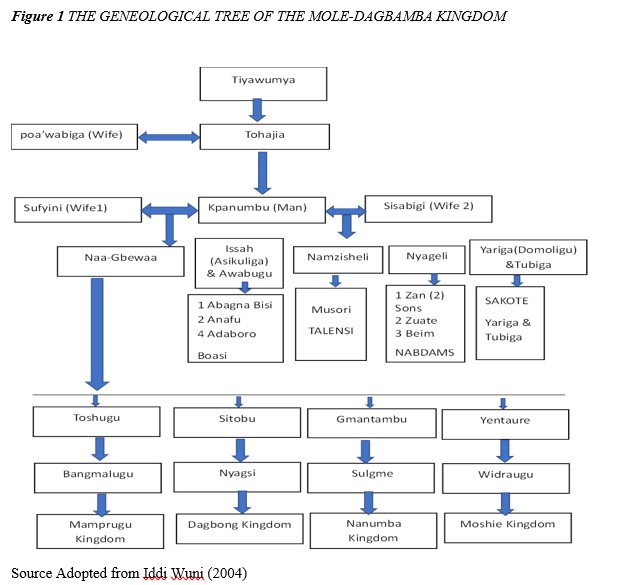
Source Adopted from Iddi Wuni (2004)
Figure 2 Kings of Mamprugu in order of Succession.
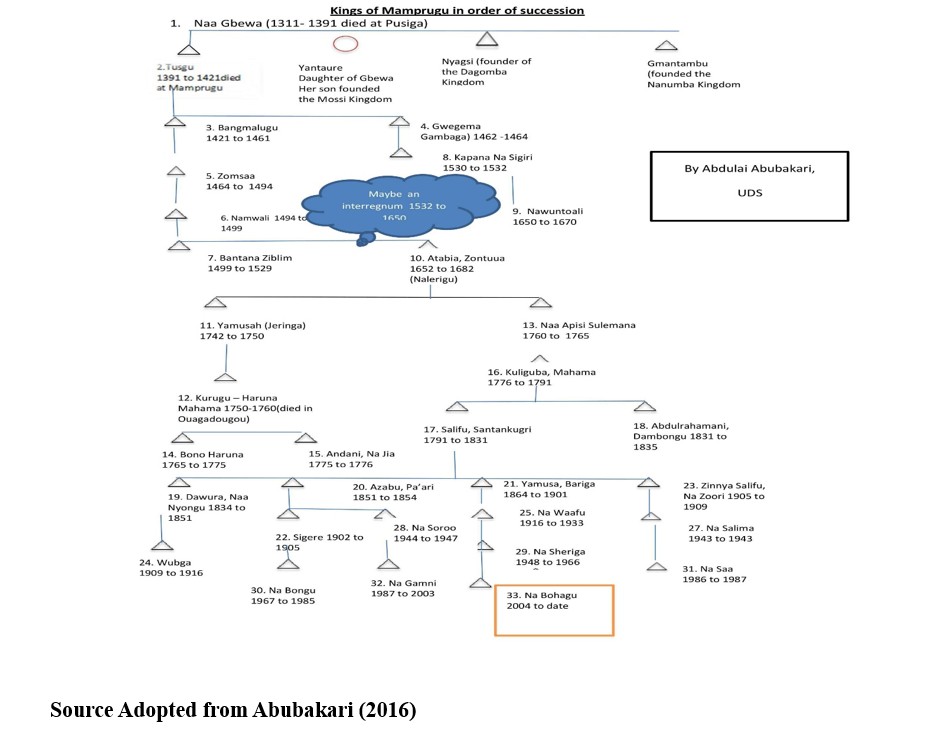
Source Adopted from Abubakari (2016)
4.3 Regional Variations in Knowledge Retention
The findings reveal a regional gradient in IKS retention: Burkina Faso (70%), Togo (60%), and Ghana (50%). This pattern underscores a geographical-cultural correlation between remoteness, language preservation, and knowledge integrity. As one elder from Yatenga (Burkina Faso) noted: “We still sing the songs our fathers sang. Nothing has changed; we still bury with the old ways.” This supports McGregor (2004), who argued that communities with minimal colonial interference retain richer Indigenous knowledge due to less epistemic erosion.
4.3.2 Quantitative Findings: Country-Level Indigenous Knowledge Retention
Empirical analysis revealed a strong correlation between age, experience, and interpretive competence, confirming that indigenous epistemic fluency diminishes with younger generations. Quantitative results are summarized in Table 1.
Table 1. Country-Level IK Performance
| Country | Total Respondents (n) | Able to Interpret All 10 | % | Unable to Interpret All 10 | % | Interpretation |
| Ghana | 10 | 5 | 50% | 5 | 50% | Lowest IKS retention; significant epistemic erosion. |
| Burkina Faso | 10 | 7 | 70% | 3 | 30% | Strongest IK retention; high oral continuity. |
| Togo | 10 | 6 | 60% | 4 | 40% | Moderate IK loss; generational weakening evident. |
(Author’s Field Data, 2023–2024)
Regional Pattern: IKS retention follows a Burkina Faso 70% → Togo 60%→ and Ghana 50% gradient, with Burkina Faso maintaining the most intact oral systems and Ghana showing the highest interpretive decline.
4.4.1 Generational Transmission and Decline
A strong correlation was observed between generational cohort and IKS fluency. The Silent Generation and Baby Boomers (60+ years) achieved interpretation scores of 85–100%, while Millennials and Generation Z showed significant erosion. A Ghanaian participant remarked: “Our children now laugh when we chant or pour libation. They call it superstition.” This aligns with Ekeh’s (1975) thesis on Africa’s dual public spheres, where colonial education undermines traditional values.
Table 2. Health-Seeking Behaviour and Treatment Preference
| Country | Prefer Hospital (%) | Prefer Herbal (%) | Interpretation |
| Ghana | 85 | 25 | Strong inclination toward biomedical care; reflects loss of herbal epistemic confidence. |
| Togo | 55 | 45 | Transitional adaptation; coexistence of indigenous and biomedical systems. |
| Burkina Faso | 40 | 60 | Predominantly herbal preference; traditional epistemic trust remains strong. |
(Author’s Field Data, 2023–2024)
A key informant from Burkina Faso noted:
“Why will I go to hospital when I can treat the sickness myself? I know the plants I use, but I don’t know what they use in their drugs.” (KII, Ouahigouya, 2024)
These generational patterns not only highlight knowledge decline but also reveal how the weakening of ancestral governance structures accelerates epistemic fragmentation among the youth. This cross-country pattern confirms a direct relationship between Indigenous Knowledge retention and preference for herbal medicine: where knowledge is high, traditional treatment is preferred; where knowledge is low, hospital preference dominates.
Table 3. Generational Analysis: Indigenous Knowledge and Health Preference
| Generational | Able to Interpret All 10 (%) | (%) | Prefer Herbal (%) | Prefer Hospital (%) | Interpretation |
| Silent Generation (80–97 yrs) | 10/10 | 100% | 95 | 5 | Deepest IKS retention; rely on nature-based healing. |
| Baby Boomers (61–79 yrs) | 8/10 | 80% | 75 | 25 | Active transmitters of IKS; retain trust in herbal systems. |
| Generation X (45–60 yrs) | 8/10 | 60% | 60 | 40 | Active transmitters of IKS; retain trust in herbal systems. Transitional; hybrid users of traditional and modern health systems. |
| Millennials / Gen Y (29–44 yrs) | 4/10 | 40% | 30 | 70 | Shift towards biomedical systems; partial cultural detachment. |
| Generation Z (13–28 yrs) | 2/10 | 20% | 20 | 80 | Highly westernized worldview; limited knowledge of indigenous therapy. |
| Generation Alpha (0–12 yrs) | 1/10 | 10% | 5 | 95 | Total dependency on biomedical models; minimal cultural transmission. |
(Author’s Field Data, 2023–2024)
Generational Trend:
A positive correlation exists between interpretive competence and preference for herbal treatment. Generations with high indigenous interpretive fluency demonstrate a strong attachment to herbal medicine and ancestral healing systems. Conversely, generations with low interpretive competence exhibit dependence on hospital-based medicine and scientific rationalism.
4.4.2 Generational-Sensitive Interpretation of Findings
The generationally stratified data affirm that Indigenous Knowledge retention determines epistemic choices in development and healthcare. This relationship is not contradictory but symbiotic, showing that:
- High IKS Retention → High Herbal Preference:
Older cohorts (Silent and Baby Boomer generations) exhibit both superior interpretive competence and stronger reliance on traditional healing systems. Their worldview is holistic, associating health with spirituality, ecology, and ancestral balance. - Low IKS Retention → High Hospital Preference:
Younger cohorts (Gen Y–Alpha) demonstrate epistemic discontinuity. Their preference for hospital systems reflects trust in scientific validation, formal education, and digital media rather than ancestral authority. - Cross-Cultural Continuity:
The same pattern cuts across Ghana, Togo, and Burkina Faso—countries with stronger IKS retention (e.g., Burkina Faso) show higher indigenous medical preference, while countries with weaker IKS retention (e.g., Ghana) show dominant hospital reliance.
4.5 Discussion/Interpretations.
This section Integrated findings, Discussion and Implications for African IKS, Development, and the Africa Future.
4.5.1. Regional Patterns of IKS Retention and Their Developmental Significance
The findings revealed a clear regional variation in IKS retention—Burkina Faso (70%), Togo (60%), and Ghana (50%). They further show that Burkina Faso and Togo, both formerly colonised by France, maintained relatively stronger Indigenous Knowledge Systems than Ghana, which was colonised by Britain. The differing colonial experiences—particularly the degree of linguistic preservation, cultural cohesion, and the nature of Western-centric education—played a significant role in shaping these outcomes. In addition to colonial histories, the relative geographical remoteness of rural Burkina Faso has allowed communities to maintain uninterrupted cultural practices and linguistic continuity, further strengthening IKS retention.
In Ghana, the deeper entrenchment of British-style schooling, Western philosophies, biomedical health systems, Western-centric science, technology and innovation, as well as the marginalisation of traditional spirituality and externally imposed development interventions, all contributed to greater IKS erosion. These structural forces collectively influenced the regional gradient of knowledge loss and shaped the continuity (or disruption) of African epistemologies.
Elders in Yatenga (Burkina Faso) affirmed that their oral traditions remain intact, illustrating McGregor’s (2004) argument that communities least disrupted by colonial education retain richer Indigenous knowledge systems. This also aligns with Odora-Hoppers’ (2002; 2020) contention that Indigenous epistemologies survive where cognitive justice is protected and where knowledge systems continue to operate within their original cosmological frames. Thus, the regional variations observed in this study reflect not merely cultural difference but the degree to which communities have preserved the cosmovision-based epistemic autonomy articulated by Millar (1999; 2006).
4.5. 2. Generational Decline: Evidence of Epistemicide and Developmental Fragility
The Three Generational analysis confirms that interpretive competence is highest among the Silent Generation and Baby Boomers (85–100%) and lowest among Millennials, Gen Z, and Gen Alpha. The younger cohorts’ detachment from IKS echoes Ekeh’s (1975) classic thesis on Africa’s “two publics,” where Western education displaces traditional epistemologies, leading to the erosion of ancestral authority. This generational shift is further reinforced by Battiste (2000) and Smith (2012), who argue that the ongoing coloniality of knowledge produces epistemicide—the killing, marginalization, or erasure of Indigenous ways of knowing. This erosion of ancestral knowledge directly undermines community resilience, leaving younger generations developmentally vulnerable and increasingly dependent on external systems. In the Mossi-Dagbamba context, this epistemicide manifests as diminishing competence in interpreting songs, symbols, proverbs, genealogy, and herbal diagnostics—foundations of African science, ethics, and ecological balance. Such decline is not only cultural; it is a developmental threat, as traditional knowledge historically sustained health, food security, conflict resolution, and biodiversity (Sobrevila, 2008; Warren et al., 1995).
4.5. 3. Health-Seeking Behaviour: IKS Retention as a Determinant of Developmental Resilience
Across countries, high IKS retention correlates with strong preference for herbal medicine: Burkina Faso (60% herbal preference) versus Ghana (25%). The preference for biomedical services among youth is not inherently problematic; rather, it reflects a shifting epistemic alignment shaped by formal schooling, religious change, and global exposure. This supports Mazzocchi’s (2006) assertion that traditional knowledge constitutes a sophisticated scientific system grounded in centuries of experimentation and adaptation. Elders’ confidence, “I know the plants I use, but I don’t know what they use in their drugs”—reflects a worldview where healing is ecological, spiritual, and cosmological (Mbiti, 1990; Mekoa, 2019). Meanwhile, youth’s preference for biomedical facilities illustrates the dominance of Western epistemologies in schooling systems, confirming Dei’s (2014) and Falola’s (2022) critiques of epistemic dependency. Thus, health behaviour patterns are not medical choices but expressions of epistemic alignment, with long-term consequences for development planning and health sovereignty.
4.5 .4. Linking IKS Retention to Vulnerability Under Donor Withdrawal
The dramatic modelling by Symons et al. (2025) shows that discontinuing USAID/Pmi support in 2025 would lead to 201,610 additional adult deaths, 419,297 child deaths, and 88 deaths per hour across sub-Saharan Africa. These deaths reveal the fragility of African health systems that have become structurally dependent on external biomedical architectures. While biomedical interventions save lives, their dominance has displaced endogenous health knowledge—notably the same herbal pharmacologies now recognized by WHO (2023) as essential to primary healthcare in many African societies.
The intersection of these findings is profound: in countries where IKS has eroded most (e.g., Ghana), populations are most vulnerable when donor funds collapse. Conversely, where IKS remains strong (e.g., rural Burkina Faso), communities have greater internal buffers. This validates Agrawal’s (1995) seminal argument that dismantling the divide between scientific and Indigenous knowledge weakens adaptive capacity. It also echoes Max-Neef’s (2005) view that development grounded in external systems produces structural dependency rather than resilience.
The observed correlations mirror the CSCCA intersectional logic:
- A ∩ B (Sense-making) → explains symbolic interpretation
- B ∩ C (Ontology) → explains spiritual–health correlation
- A ∩ C (Realism) → explains herbal knowledge patterns
- A ∩ B ∩ C (Holism) → strongest among elders
Thus, the dataset empirically confirms the mathematical logic embedded in the CSCCA framework.
4.5.5. Structural Dependency, Epistemic Disconnection, and the Future of African Development
The rise in mortality from donor withdrawal is thus more than a biomedical concern—it reflects Africa’s dangerous over-reliance on external knowledge, foreign finance, and donor-driven survival systems. As Mignolo (2009) notes, dependence on Western epistemologies restricts Africa’s ability to build autonomous futures. While Mignolo highlights the need for epistemic disobedience to escape Western ontologies, Iaccarino reinforces this by arguing that scientific pluralism—rather than Western dominance—provides the most sustainable foundation for societal advancement. Iaccarino (2003) similarly argues that Western science, while powerful, cannot replace local scientific traditions, especially in societies rooted in ecological interdependence. When external support collapses, communities without strong IKS foundations suffer double harm: first from biomedical system failures, and second from epistemicide, the loss of ancestral knowledge holders who die prematurely (Visvanathan, 2009).
This situation reinforces Millar’s (2014) and Millar & Derbile’s (2018) argument for endogenous development, which emphasizes internal resources, Indigenous knowledge, and community-based innovation as the foundation for sustainable development. Donor dependency contradicts endogenous development and weakens Africa’s ability to control its developmental agenda.
4.5.6. CSCCA Implications: Ancestorcentrism as a Framework for Rebuilding African Knowledge Sovereignty
The findings strongly align with the Cosmic System Constellations of Cosmovision in Ancestorcentrism (CSCCA) framework (Jambedu, 2020; Millar, 2006). According to CSCCA:
- Elders embody the highest interpretive competence linking the physical, spiritual, ecological, and ancestral realms.
- Loss of elders due to preventable disease produces cosmological disintegration, not merely demographic decline.
- Declining IKS signals weakening spiritual-ecological balance, a central component of African wellbeing as conceptualized by Krause’s panentheistic metaphysics (Goecke, 2018) and Ubuntu relationality (Ramose, 2002).
- Strong IKS retention fosters resilience, communal coherence, and adaptive capacity—features central to transdisciplinary sustainability (Werlen, 2015; Nicolescu, 2005).
Thus, when donor-funded systems fail, communities with strong IKS (high constellational coherence) withstand shocks better than highly Westernized cohorts, validating both the Trans-Level logic of CSCCA and African holistic paradigms.
4.5.7. Moving Beyond Numbers: A Call for Cognitive Justice and African Knowledge Sovereignty
Finally, these findings highlight the need to move beyond numerical indicators to understand the deeper human and philosophical losses inherent in knowledge erosion. As Visvanathan (2009) notes, cognitive justice requires valuing all knowledge systems equally. Behind every malaria-related death caused by donor withdrawal lies not just a human life lost but a ruptured link in the living chain of African ancestral knowledge—songs, genealogies, herbal formulas, spiritual rituals, and ecological wisdom that cannot be replaced.
This aligns with Sun (2021), Husserl (1931), and Rousseau & Billingham (2018) who argue that worldviews—not data—shape how societies perceive and respond to crises. In African contexts, where ancestors mediate morality, ecology, and wellbeing, each preventable death represents a cosmological loss. Therefore, strengthening IKS is not cultural conservation—it is a continental survival strategy and a prerequisite for Africa’s future development.
5.0 Summary of Findings
5.1. Regional Variance in Knowledge Retention
Verbatim Quote: “Where culture is intact, knowledge endures.”
(KII with Elder Aruna, 24/10/2023, Yatenga, Burkina Faso)
- A distinct regional gradient of Indigenous Knowledge Systems (IKS) retention exists: Burkina Faso > Togo > Ghana.
- Rural Burkina Faso demonstrates the strongest preservation of ancestral knowledge.
- This pattern was confirmed through multiple discussions, including a CAD in Dapaong, Togo (CAD, 10/10/2023) and KIIs in Binde, Ghana (KII with Teacher Gumah, 18/09/2023).
5.2. Generational Decline of IKS
Verbatim Quote: “When the elders fade, the kingdom’s memory fades with them.”
(FGD with Chiefs & Elders, 27/09/2023, Mamprugu, Ghana)
- The Silent Generation (80–97 yrs), Baby Boomers (61–79 yrs), and Gen X (45–60 yrs) exhibit the highest interpretive competence across Nord/Yatenga (Burkina Faso), Tanjore/Dapaong (Togo), and North-East Ghana.
- IKS retention declines sharply among Gen Y, Gen Z, and Gen Alpha.
- A youth participant in Tanjore, Togo (SRP session, 12/10/2023) remarked: “We don’t know the old chants; they belong to the elders.”
5.3. Drivers of Knowledge Erosion
Verbatim Quote: “Knowledge does not die on its own—systems kill it.”
(CAD, 11/10/2023, Dapaong, Togo)
Major historical, cultural, and structural forces causing IKS decline include:
- Loss of Indigenous languages (e.g., Mampruli, Mòoré, Dagbani), noted during SRP sessions in Yatenga, Burkina Faso (22/10/2023).
- Marginalisation of traditional spirituality; elders lamented during CIs and SPRs in Tong, Northern Ghana (20/09/2023) that youth “fear church rejection.”
- Colonial domination in health, education, ST&I—observed across KIIs in Ghana and Togo.
- Western-centric education systems disconnected from local realities (FGD with teachers, 09/10/2023, Dapaong, Togo).
- Over-reliance on Western philosophies and biomedical pathways (DPMP session in Gambaga, Ghana, 19/09/2023).
- Globalisation pressures and digital culture replacing Indigenous memory (KII with Gen Z, 21/09/2023, Bawku, Ghana).
- Development interventions privileging external expert knowledge over traditional custodians (HSAM in Yatenga shrines, 23/10/2023, Burkina Faso).
Synthesis:
IKS loss is rooted in colonial marginalisation and reinforced by globalisation, Western education, biomedical dominance, and externally driven development models.
5.4. IKS and Health Systems
Verbatim Quote: “What people know determines where they seek healing.”
(KII with Herbalist Naba Kombat, 25/10/2023, Ouahigouya, Burkina Faso)
- Communities with strong IKS demonstrate high confidence in herbal and spiritual healing.
- Pluralistic health systems were observed: combining traditional healers, herbal preparations, and biomedical clinics.
- In Binde, Ghana (KII, 18/09/2023), one elder explained:
“The hospital treats the body; the herbs treat the spirit and the body.”
5.5. Participatory Tools as Cognitive Scaffolds
Verbatim Quote: “When people map their past, they reclaim their future.”
(DPMP Session, 13/10/2023, Tanjoure, Togo)
- Tools such as Three-Generational Trees (TGTs) and Dynamic Posters and Mind Mapping (DPMP) proved effective for:
- Tracing genealogies (TGT, 20/10/2023, Nord-Burkina Faso)
- Documenting ritual practices (DPMP, 13/10/2023, Tanjoure, Togo)
- Mapping ancestral governance histories (IAR & HSAM, 16–30/10/2023, Burkina Faso; 1–15/10/2023, Togo; 15–30/09/2023, Ghana)
- These tools strengthened community memory, identity, and cosmological understanding, especially among younger generations.
5.6. Empirical Validity of CSCCA
Verbatim Quote: “African spirituality is not abstract—it is measurable.”
(Team Data Review Workshop, 30/10/2023, Bolgatanga, Ghana)
- The Cosmic System Constellations of Cosmovision in Ancestorcentrism (CSCCA) was statistically validated using SPSS.
- This shows that Indigenous spiritual–cultural knowledge systems can be empirically quantified, not merely narrated.
- Findings were confirmed through triangulation across KIIs, CADs, TGTs, DPMP, FGDs, HSAM, and SRP sessions.
6.0 Conclusions
The study concludes that Ancestorcentrism is both a philosophical worldview and an empirical development framework. Through a mixed-method design and CSCCA modelling, this research empirically maps how Indigenous knowledge is retained, transmitted, or lost across six distinct generational cohorts among the Mossi-Dagbamba people of Ghana, Togo, and Burkina Faso.
This conclusion also reaffirms the funnel-shaped logic of the study, moving from global patterns of epistemic marginalisation to the lived realities of the Mossi–Dagbamba across Ghana, Togo, and Burkina Faso.
The unique conclusions affirm that:
- IKS is a living, functional epistemology, deeply embedded in African cosmology and development processes.
- Erosion of IKS is structural, generational, and systemic, but can be reversed through targeted cultural, educational, and policy reforms.
- CSCCA bridges African ancestral wisdom with empirical science, offering a scalable and diagnostic tool for African-centred development planning.
- IKS retention is directly linked to development resilience, while generational loss of metaphysical and ecological knowledge weakens health systems, governance systems, and community identity.
- Dependency on external funding is dangerous, as demonstrated by health-system collapse when donor support is withdrawn; communities with strong IKS survive shocks better than those dependent on external biomedical systems.
Thus, the study positions Ancestorcentrism as a foundation for rethinking development—not as material accumulation, but as ontological completeness, spiritual integrity, intergenerational continuity, and cultural sovereignty.
This study demonstrates that Indigenous cosmological knowledge is not only philosophically rich but also methodologically quantifiable. The successful operationalisation of the CSCCA framework marks a significant breakthrough in African epistemology, bridging the long-standing divide between narrative wisdom and empirical science.
7.0 Recommendations
The findings lead to the following coherent recommendations:
7.1. Curriculum Reform & Epistemic Integration
- Embed IKS and Ancestorcentrism into national curricula.
- Create platforms for dialogue between Western and Indigenous epistemologies.
- Recognise herbalists, dirge singers, blacksmiths, spirit medium custodians, and oral historians as legitimate knowledge bearers.
7.2. Strengthening Intergenerational Transmission
- Institutionalise TGTs and participatory visual tools for cultural apprenticeship.
- Develop elder-youth mentorship programs that sustain ritual practice and ancestral governance.
7.3. Linguistic & Cultural Revitalization
- Prioritize local language instruction across all levels.
- Digitize endangered oral traditions, chants, songs, and medicinal knowledge.
7.4. Health System Pluralism
- Formalize partnerships between biomedical practitioners and traditional healers.
- Develop policies that recognize traditional medicine as parallel—not inferior—health infrastructure.
7.5. Cultural Digitization & Archiving
- Establish community-owned digital archives governed by customary protocols.
- Preserve genealogies, rituals, totems, oral maps, and indigenous pharmacologies.
7.6. Institutional & Policy Recognition
- Reform accreditation, research protocols, and funding systems to legitimize IKS innovation.
- Support community-based endogenous development as articulated by Millar (2014).
7.7. Pan-African Replication of CSCCA
- Extend CSCCA testing across other African regions.
- Build a continental dataset for comparative Indigenous epistemology and policy adoption.
8.0 Contributions to New Knowledge
This study makes several original scholarly contributions:
8.1. CSCCA as a New Empirical Framework
For the first time, a cosmological and spiritual African knowledge system is statistically validated, proving that IKS can be quantified through diagnostic tools.
8.2. Advancing Transdisciplinary African Epistemology
The study merges cosmology, philosophy, ecology, and culture into a unified system of knowledge, advancing African transdisciplinary theorization beyond Eurocentric boundaries.
8.3. Decolonial & Cognitive Justice Framework
It offers a counter-hegemonic model that restores legitimacy to African metaphysical and ancestral knowledge within global science.
8.4. Operational Preservation Tools
By validating TGTs and Dynamic Posters, the study creates practical tools for tracing genealogies, rituals, cosmologies, and governance systems.
8.5. Foundational Model for Gross Societal Wellbeing (GSW)
It introduces an African metric of wellbeing rooted in cultural balance, ancestral alignment, ecological integrity, and spiritual coherence.
9.0 Final Reflection
As global forces increasingly standardize knowledge, culture, and development thinking, this study affirms that Ancestorcentrism is not merely a memory of the past or an artefact of cultural nostalgia, it is a pathway to Africa’s future. It provides a practical, measurable, and spiritually grounded methodology for building development models that are locally rooted, ethically sound, and globally relevant.
Moving Beyond Science and Numbers is therefore a philosophical reminder that quantitative indicators alone cannot capture the deeper meaning of human stories, realities, spiritual ruptures, or cultural losses inherent in Indigenous Knowledge erosion. Numbers may measure outcomes, but they cannot measure the disappearance of ancestral memory, the collapse of cosmological meaning, or the extinction of community identity. In this sense, the erosion of IKS is not only a cultural concern, it is an existential one.
The evidence from this study is clear: communities with strong Indigenous Knowledge Systems survive crises better, adapt faster, and retain stronger social cohesion. Conversely, communities that have abandoned their ancestral foundations are the most vulnerable when external systems, for example, governance and justice system, conflict resolution strategies, resources in terms of human, natural, funding, technical expertise, or global development mechanisms fails. The fragility of dependence on Western models exposes the urgent need to rebuild Africa’s internal knowledge architecture.
For this reason, strengthening IKS is not optional, it is a community, regional/continental survival strategy. Anchored within the Cosmic System Constellations of Cosmovision in Ancestorcentrism (CSCCA) framework, this study demonstrates how ancestral wisdom, when paired with empirical validation, can open new horizons for epistemological liberation, endogenous development, and pan-African regeneration.
Thus, Ancestorcentrism becomes more than a theoretical construct; it becomes a guiding philosophy for reclaiming Africa’s cultural sovereignty, healing generational fractures, and designing futures grounded in Indigenous integrity. It offers the moral, spiritual, and intellectual foundations for building societies that honour their past while imagining sustainable futures.
The diagrams that follow summarise the integrated CSCCA and Gbewaa Development Framework. The naming of the framework reflects the unique contributions of Naa Gbewaa, whose leadership, moral authority, and ancestral presence continue to shape the identity and cosmology of the Mole–Dagbamba across Ghana, Togo, and Burkina Faso.
The framework shows that Culture and Art (C.A.) form the foundational pillars of all worldviews and cosmologies. These cultural foundations shape and sustain Indigenous Knowledge Systems and the underlying Indigenous Philosophy (I. PHILO). In turn, this philosophy informs the Indigenous Scientific inquiries, Technology and Innovation (ISTI), which collectively drive Endogenous Development (ED), as presented in Figures 3 and 4.
- Figure 3 illustrates the conceptual basis for the Gbewaa Development Model.
- Figure 4 highlights the philosophical foundations that guide the framework.
This conceptualisation aligns with African worldviews and cosmologies that honour heroes and heroines for their unique contributions to community survival, continuity, and identity as an essential principle within Ancestorcentrism.
Figures 3 and 4 below provide the visual conceptualisation of this integrated framework.
Source: Jambedu (2024) Figure 2: The Philosophy Behind the Development.
References
Agrawal, A. (1995). Dismantling the Divide Between Indigenous and Scientific Knowledge. Development and Change, 26(3), 413–439. https://doi.org/10.1111/j.1467-7660.1995.tb00560.x
Battiste, M. (2000). Reclaiming Indigenous Voice and Vision. UBC Press.
Benedikt Paul Göcke. (2018). The Panentheism of Karl Christian Friedrich Krause (1781-1832): From Transcendental Philosophy to Metaphysics. Peter Lang Publishing Group. https://doi.org/DOI 10.3726/b13320
Benno Werlen. (2015). Global Sustainability Cultural Perspectives and Challenges for Transdisciplinary Integrated Research (Benno Werlen, Ed.). Springer. https://doi.org/DOI 10.1007/978-3-319-16477-9
Braun, V., & Clarke, V. (2019). Reflecting on reflexive thematic analysis. Qualitative Research in Sport, Exercise and Health, 11(4), 589–597. https://doi.org/10.1080/2159676X.2019.1628806
Brenner, J. E., & Igamberdiev, A. U. (2019). Philosophy in reality: Scientific discovery and logical recovery. Philosophies, 4(2), 1–45. https://doi.org/10.3390/philosophies4020022
Dei, G. J. S. (2014). Indigenous Philosophies and Critical Education. Peter Lang.
Ekeh. G. (2020). African Ontology as a Basis for African Existential Practices: Implications for African Education. Journal of Education and Human Development Vol. 9, No. 3, pp. 88-92, September 2020, ISSN: 2334-296X (Print), 2334-2978 (Online) DOI: 10.15640/jehd. V9n3a9 OR URL: https://doi.org/10.15640/jehd.v9n3a9.
Ekore, R. I., & Lanre-Abass, B. (2016). African cultural concept of death and the idea of advance care directives. In Indian Journal of Palliative Care (Vol. 22, Issue 4, pp. 369–372). Medknow Publications. https://doi.org/10.4103/0973-1075.191741
Ekore, R. I., & Lanre-Abass, B. (2016). African cultural conceptions of death and the challenges of organ donation. Developing World Bioethics, 16(2), 67–74. https://doi.org/10.1111/dewb.12095
Etuk, R. A. and Silas, C. A. (2020). ISSUES AND POTENTIAL IN AFRICAN EPISTEMOLOGY. Journal of African Studies and Sustainable Development. ISSN: 2630-7065 (Print) 2630-7073 (e). Vol. 3 No. 3. 2020. https://doi.org/10.13140/RG.2.2.12616.55046
Falola, T. (2022). Decolonizing African Studies: Knowledge Production, Agency, and Voice. Routledge.
Freire, P. (1970). Pedagogy of the Oppressed.
Gibbs, P. (2017). Transdisciplinary higher education: A theoretical basis revealed in practice. In Transdisciplinary Higher Education: A Theoretical Basis Revealed in Practice. https://doi.org/10.1007/978-3-319-56185-1
Giri, A. K. (2021). Pragmatism, Spirituality and Society Border Crossings, Transformations and Planetary Realizations. https://doi.org/https://doi.org/10.1007/978-981-15-7102-2
Göcke, P. B. (2018). The Panentheism of Karl Christian Friedrich Krause (1781-1832): From Transcendental Philosophy to Metaphysics. Peter Lang Publishing Group. https://doi.org/DOI 10.3726/b13320
Groh, A. (2006). Globalisation and indigenous identity. Psychopathologie Africaine, 33(1), 33–47.
Groh, A. (2018b). Research methods in indigenous contexts. In Research Methods in Indigenous Contexts. Springer International Publishing. https://doi.org/10.1007/978-3-319-72776-9 ISBN 978-3-319-72774-5 ISBN 978-3-319-72776-9 (eBook) https://doi.org/10.1007/978-3-319-72776-9 Library.
Hountondji, P. (2017). The Struggle for Meaning: Reflections on Philosophy, Culture, and Democracy in Africa. Ohio University Press
Husserl, E. (1931). Ideas: General introduction to pure phenomenology (W. R. Boyce Gibson, Trans.). George Allen & Unwin.
Iaccarino, M. (2003). Science and culture. Western science could learn a thing or two from the way science is done in other cultures. EMBO Reports, 4(3), 220–223. https://doi.org/10.1038/sj.embor.embor781
Jambedu, T. A. (2020). Re-Constructing the Role of Ancestorcentrism Amongst the Mole-Dagbani Ethnic Group of People in Ghana, Togo, and Burkina Faso. Unpublish Thesis Presented to Millar Institute for Transdisciplinary and Development Studies 12th September, 2024 Bolgatanga, Ghana.
Klein, J. T. (2010). A taxonomy of interdisciplinarity. Oxford Handbook of Interdisciplinarity.
Leach, M., Scoones, I., & Wynne, B. (2012). Science and Citizens: Globalization and the Challenge of Engagement. Zed Books.
Lynch, J. M., Dowrick, C., Meredith, P., McGregor, S. L. T., & van Driel, M. (2021). Transdisciplinary Generalism: Naming the epistemology and philosophy of the generalist. Journal of Evaluation in Clinical Practice, 27(3), 638–647. https://doi.org/10.1111/jep.13446
Max-Neef, M. A. (2005). Foundations of transdisciplinarity. Ecological Economics.
Mazzocchi, F. (2006). Western science and traditional knowledge: Despite their variations, different forms of knowledge can learn from each other. EMBO Reports, 7(5), 463–466. https://doi.org/10.1038/sj.embor.7400693
Mbiti, J. S. (1990). African Religions and Philosophy. Heinemann.
McGregor, S. L. T. (2018). Philosophical Underpinnings of the Transdisciplinary Research Methodology. Transdisciplinary Journal of Engineering & Science, 9. https://doi.org/10.22545/2018/00109
McGregor, S. L. T. (2020). Transdisciplinarity and Transpraxis. Transdisciplinary Journal of Engineering & Science, 11. https://doi.org/10.22545/2020/00134
McGregor, S. L. T., & Donnelly, G. (2014). Transleadership for transdisciplinary initiatives. World Futures, 70(3–4), 164–185. https://doi.org/10.1080/02604027.2014.934625
McGregor, S. L. T., & Gibbs, P. (2020). Transdisciplinary philosophy, theory, and practice. Integral Review, 16(1), 161–192.
Mekoa, I. (2019). The Living-Dead/Ancestors as Guardians of Morality in African Traditional Religious Thought. Global Journal of Archaeology & Anthropology, 10(5). https://doi.org/10.19080/gjaa.2019.10.555799
Mignolo, W. D. (2009). Epistemic Disobedience, Independent Thought and De-Colonial Freedom. Theory, Culture & Society, 26(7–8), 159–181.
Millar, D. (2006). Ancestorcentrism: A basis for African sciences and learning epistemologies. In: Millar, D., Kendie, S.K., Apusigah, A.A. and Haverkort, B., Eds., African Knowledges and Sciences Understanding and Supporting the Ways of Knowing in Sub-Saharan Africa, BDU, Barneveld, 53-63. ISBN-10: 90-77347-11-9, ISBN-13: 978-90-77347-11-9
Millar, D. (2014). Endogenous development: some issues of concern. Https://Doi.Org/10.1080/09614524.2014.938615, 24(5–6), 637–647. https://doi.org/10.1080/09614524.2014.938615
Millar, D., & Derbile, E. K. (2018). Operational Methodology for Endogenous Development Research (First Ed.). AIT CONSULT.
Millar, D., & Yelsang, D. (2016). Illuminating African Knowledge Systems: the Need for a Contemporary Development Agenda. International Journal of Advanced Research, 4(8), 1192–1209. https://doi.org/10.21474/ijar01/1321
Millar, D., (1999). Traditional African Worldviews from a cosmovision perspective. Eds.: B. Haverkort and Hiemstra, W., FOOD FOR THOUGHT Books for Change, Bangalore – India. P 131 – 138.
Mokiy, V. (2010). Centrism of Unity: A Philosophical Approach to Complex System Analysis. World Futures, 66(7-8), 494-507.
Mokiy, V. (2019). Systems Transdisciplinary Approach in the General Classification of Scientific Approaches. European Scientific Journal ESJ, 15(19). https://doi.org/10.19044/esj.2019.v15n19p247
Mokiy, V. Lukyanova, T. (2017). Methodology of Scientific Research. Transdisciplinary Approaches and Methods. Yurayt, Moscow, p. 46.
Mokiy, V. S., & Lukyanova, T. A. (2021). Transdisciplinarity: Marginal trend or global approach in contemporary science? Philosophy and Cosmology, 26, 52–62. https://doi.org/10.29202/phil-cosm/26/6
Mokiy, V. S., & Lukyanova, T. A. (2022). Modern Transdisciplinarity: Results of the Development of the Prime Cause and Initial Ideas. 19, 2022. https://doi.org/10.28945/4951
Mokiy, V., & Lukyanova, T. (2021). Transdisciplinarity: Marginal Direction or Global Approach of Contemporary Science? Informing Science, 24, 1–18. https://doi.org/10.28945/4752
Muhamba, D., Sanga, I., & Ndemo, G. (2023). The Metaphysics of Time and Temporal Experience in Africa: A Cultural and Philosophical Perspective. East African Journal of Arts and Social Sciences, 6(1), 272–281. https://doi.org/10.37284/eajass.6.1.1187
Nicolescu, B. (2002). Manifesto of transdisciplinarity. SUNY Press.
Nicolescu, B. (2005). Transdisciplinarity – Past, Present and Future. Ii, 1–24.
Nicolescu, B. (2019). Transdisciplinarity Approach to Strong Sustainability.
Nyerere, J. (1968). Ujamaa: Essays on Socialism. Oxford University Press.
Odora Hoppers, C. A. (2002). Indigenous Knowledge and the Integration of Knowledge Systems: Towards a Philosophy of Articulation. New Africa Books.
Odora Hoppers, C. A. (2020). Cognitive Justice and Integration of Knowledge Systems: Towards a Conceptual Framework. Indilinga: African Journal of Indigenous Knowledge Systems, 19(1).
Piaget, J. (1972). The epistemology of interdisciplinary relationships. In L. Apostel et al. (Eds.), Interdisciplinarity: Problems of teaching and research in universities (pp. 127–139). OECD.
Plockey, F. D. D., & Ahamed, B. A. B. (2016). Decolonizing our library system: The living librarians (Baansi) of Dagbon, Northern Ghana. Library Philosophy and Practice, 2016(1).
Ramose, M. B. (2002). African Philosophy through Ubuntu. Mond Books.
Rousseau, D., & Billingham, J. (2018). A systematic framework for exploring worldviews and their generalisation as a multi-purpose inquiry framework. Systems, 6(3). https://doi.org/10.3390/systems6030027
Santuah, F. N. (2020). Food Security Policy and Sustainable Food System: Perspectives from Smallholder Farmers in Ghana and Burkina Faso. Unpublish Thesis Presented to Millar Institute for Transdisciplinary and Development Studies 10th March 2020 Bolgatanga, Ghana.
Schmidt, P. R. (2009). Iron Technology in East Africa: Symbolism, Science, and Archaeology. Indiana University Press.
Sillitoe, P. (2007). Local Science vs Global Science: Approaches to Indigenous Knowledge in International Development. Berghahn Books
Smith, L. T. (2012). Decolonizing Methodologies: Research and Indigenous Peoples. Zed Books.
Sobrevila, C. (2008). The Role of Indigenous Peoples in Biodiversity Conservation. World Bank.
Sun, Z. (n.d.). (2021). Critique of Thought (C. Mei Yang Jilin University Changchun, Trans.). Springer Nature Singapore Pte Ltd. 2021. https://doi.org/10.1007/978-981-15-8399-5
UNESCO. (2001). Universal Declaration on Cultural Diversity.
van Rooyen, J. A. (2018). Transcendence, immanence and religious experience in a post-transcendence era. Verbum et Ecclesia, 39(1). https://doi.org/10.4102/ve.v39i1.1838.
Visvanathan, S. (2009). The Search for Cognitive Justice. India International Centre Quarterly, 35(1), 8–20.
Warren, D. M., Slikkerveer, L. J., & Brokensha, D. (1995). The Cultural Dimension of Development: Indigenous Knowledge Systems. Intermediate Technology Publications.
Wiredu, K. (2004). A Companion to African Philosophy. Blackwell.
World Health Organization (WHO). (2023). Traditional, Complementary and Integrative Medicine Global Report.
Tasmin L. S. et al. (2025). Estimating the potential malaria morbidity and mortality avertable by the President’s Malaria Initiative in 2025: a geospatial modelling analysis. doi: https://doi.org/10.1101/2025.02.28.25323072