
By Jõvan Ranalfo Samson
Abstract
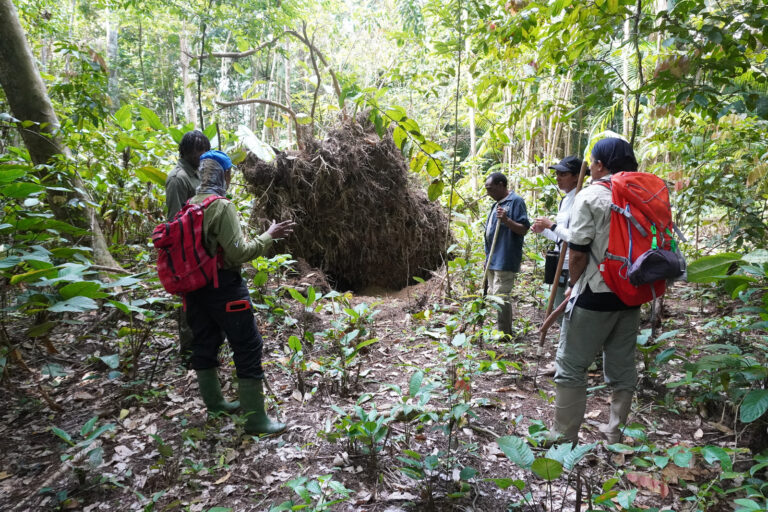
During a field visit at Plantation Toledo, situated on the right bank of the Suriname River, the researcher identified a low fired ceramic sherd on the surface of Feature 1, previously known as the Ston futu island (Figure 1). Even though the site had a decent representation of all typical historic artifacts known in Suriname, this particular find was noteworthy since empirical data indicates that these types of potteries were manufactured locally. What makes this find particularly compelling is its direct connection to Afro-Surinamese cultural traditions, by which women draw on generations of traditional knowledge. This suggests that this sherd might originate either from Toledo itself or from nearby plantations in the surrounding landscape.
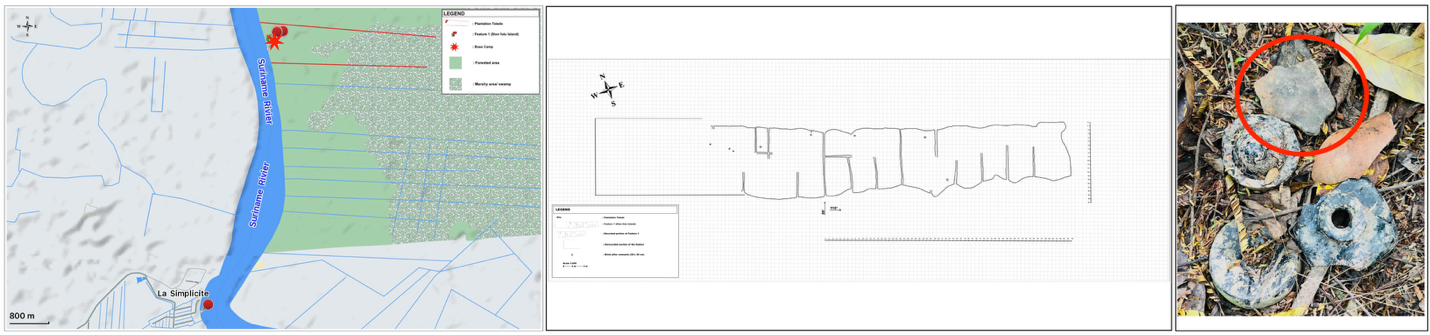
Figure 1: left: Map depicting Plantation Toledo. Center: preliminary scale drawing of Feature 1. Right: low fired sherd in red (Map & Scale drawing: Jõvan Ranalfo Samson, 08 Mar 2026; Photo: Sushmeeta Ganesh: 27 Feb 2026).
The idea of writing this abstract came during a brief explanation regarding the locally made potteries. Additionally, in anticipation of what archaeological excavations at Toledo might yield, this abstract will briefly outline the differences between soft paste and hard paste ceramics, as well as the scientific methods employed by historic archaeologists working in Suriname.
Soft paste & hard paste ceramics
Before further elaborating on the aforementioned, the researcher will briefly discuss how ceramic sherds have been interpreted in previous archaeological research conducted in Suriname. Generally, ceramics have played a central role in the development of archaeological research and represent the largest class of artifacts recovered during excavations at historical sites (Barker & Majewski, 2006, p. 205). During research at Jodensavanne, Samson & Ganesh (2022, p. 57) distinguished this artifact type in Soft paste & Hard paste ceramics.
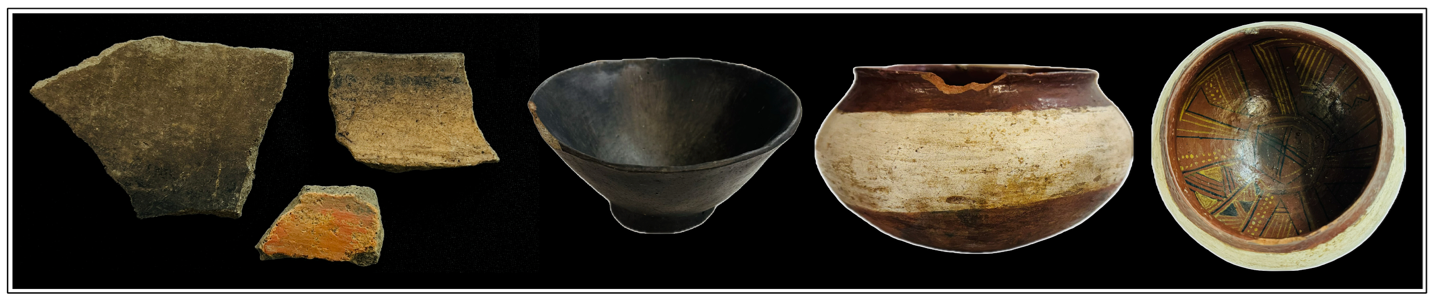
Figure 2: examples of undecorated and decorated sherds, Kali’na sherds, Maroon ceramic, and Wayana ceramic (Samson & Ganesh, 2024, p. 35; Samson, 2025, p. 46, 49).
Soft paste ceramics, or low fired ceramics, are fired at a temperature between 800 and 1150 degrees Celsius and are usually classified as decorated & undecorated sherds. When placed in context, the decorated sherds can be further identified as Amerindian, Maroon and Pre-Columbian ceramics. In a more recent study, Samson (2025, p. 38, 43) further classified the Amerindian ceramics to the Lokono, Kari’na, Wayana and Akurio cultures, while the Saamaka tradition was the only culture that could be clearly identified for the Maroon ceramics (Figure 2).
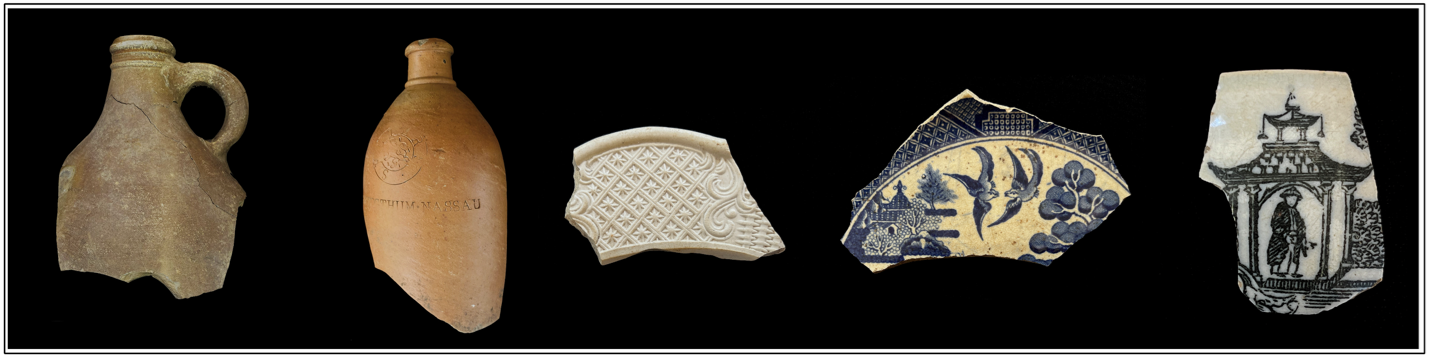
Figure 3: examples of Stoneware jug; the Nassau stoneware; white salt glazed dot- diaper- basketweave: 1685-1785, refined earthenware Willow pattern:1783-1873, Chinese porcelain: post 1820 (Samson & Ganesh, 2022, p. 67, 107).
Furthermore, Hard paste ceramics are fired at a temperature between 1000-1200 degrees Celsius and have European origins. Samson & Ganesh (2022, p. 57) further categorize these in Tin glazed earthenware, Refined earthenware, Stoneware and Coarse earthenware (Figure 3). In addition to the paste typology, ceramic decorative features can also be used as an important relative dating method.
Absolute and relative dating methods
In general, archaeological research strongly relies on absolute dating methods to provide conclusive interpretations. Absolute dating is a unit of scientific measurements to determine the age on a specified chronology. Within this discipline, radiocarbon dating is an alternative for describing perishable and immaterial finds for archaeological research. Using this method, archaeologists around the world are able to reconstruct ancient diets by analyzing the carbon and nitrogen stable isotopes preserved in material remains. Relative dating, which is another approach to scientifically determine the chronological age, determines the relative order of past events by comparing the age of different objects with each other. This method is especially used by archaeologists who work on historic sites with well-documented information, like archival and other written documents, and can therefore make descriptions by analyzing the changes in technology and styles of material culture (Kelly & Thomas, 2013, p. 118, 142, 239; Samson & Ganesh, 2022, p. 56).

Figure 4: a schematic overview depicting the different ceramic types and their production periods (Samson & Ganesh, 2022, p. 58).
Taking the above into account, archaeologists can use the ceramic manufacturing periods as a way to determine the chronological context of the site (Figure 4). However, for the comparative study to provide accurate data, artifacts have to be excavated with the proper field methods. One crucial element for this study is the scientific method of collecting artifacts based on the arbitrary and stratigraphy layers, which according to Kelly & Thomas (2013, p. 97), can provide a relative dating order based on the Law of Superposition. Also known as Steno’s law, the essence here is that artifacts in undisturbed stratigraphic layers are older than artifacts in the layers above and younger than artifacts in the layers below (Samson & Ganesh, 2022, p. 56).
Toledo
Returning to the soft paste sherd mentioned earlier, the location where this artifact was found is indicated with an “X” in Figure 5. Together with glass and stoneware fragments, the sherd appears to have been brought to the surface by an uprooted tree. Although it wasn’t collected, the researcher recognized its physical characteristics based on prior excavations on other archaeological sites in Suriname, such as Jodensavanne, Beng Tapu, and plantation Esther’s Rust at the Warappa Creek.
As mentioned earlier, empirical data suggests that these objects were locally manufactured by Amerindian- and Afro-women (Samson, 2025, p. 26, 54). From an ethnographic perspective, soft-paste ceramics were used as cooking and storage vessels, including pots and jars for storing water, and may also have served medicinal or ritual purposes. According to Hofman & Jacobs (2004) and Vredenbregt (2004), the knowledge required to produce these types of ceramics, including locating suitable clay deposits, which could often only be extracted during periods of low river tide, was traditionally held by women. Women also possessed the knowledge for making pottery by hand and to fire them at the right temperature (Hofman &Jacobs, 2004, p. 31; Vredenbregt, 2004, p. 78, 112).
Figure 5: left: the “X” indicates the location of the soft paste ceramic sherd (Scale drawing: Jõvan Ranalfo Samson, 08 Mar 2026). Right: the soft paste ceramic sherd (Photo: Sushmeeta Ganesh: 27 Feb 2026).
Besides their unique decoration patterns, Afro and Amerindian ceramics are both manufactured differently. Amerindian ceramics have a terra cotta clay paste type with sand/shell, charcoal, fiber and quartz and have a red slip on the interior and exterior surface. The clay that is used to make these types of potteries is fine-grained clay and is acquired from the riverbeds. Unlike the Amerindian ceramics, clay for making Afro-Surinamese pottery was extracted from creeks. This is white clay and is locally known as Pimba Doti. These days, Saamaka women from the traditional village of Pikin Slee still use these ceramics as cooking pots, as well as for medicinal and ceremonial purposes. The manufacturing process for Maroon potteries has been documented in great detail by AdeKUS Archaeologist, Cheryl White PhD, in 2021 (Samson, 2025, p. 26, 54).
In this documentary, titled Diima Doti, we see how the extracted creek clay is dried in the sun, and how charcoal is added to prevent the vessels from breaking during the firing process. The charcoal, specifically from the fired bark of the Basralocus (Dicorynia guianensis) or Kwepie (Cuepia guianensis) trees, is crushed, sieved and added to the clay mixture. To form the vessels, the mixture was shaped by hand using calabash and old corn cobs. After the shaping process, the vessels were polished with river pebbles and left to dry. In the end, the vessels were fired under a layer of dried bark, during which husks of upland rice was added. The latter gives Maroon potteries its striking characteristic, namely its black-gray paste color, as depicted in Figure 2 (Samson, 2025, p. 26).
References
Barker, D. & Majewski T. (2006). Ceramic Studies in historical archaeology. In Hicks D. & Beaudry M.C. (eds.). The Cambridge Companion to Historical Archaeology. P. 205-231. Cambridge: Cambridge University Press.
Hofman, C.L. & Jacob L. (2004). Different or alike? A technological comparison between late-prehistoric ceramics and modern-day folk pottery of St. Lucia (W.I.). In van As A. (ed). Leiden Journal of Potteries Studies, Volume 20. P. 23-52. The Netherlands: Faculty of Archaeology/Leiden University.
Kelly, R. & Thomas, D. H. (2013). Archaeology. Wadsworth: Cengage Learning.
Samson, J. R. (2025). Exploring Archaeological Heritage: the archaeological value of the Suriname collection in the Wereldmuseum. Leiden: Leiden University.
Samson, J. R. & Ganesh, S. T. (2022). Excavating Sephardic Legacies: Volume 1 an archaeological investigation of House De Meza at the Jodensavanne Village Plaza. Paramaribo: Jodensavanne Foundation.
Samson, J. R. & Ganesh, S. T. (2024). Lost recollections: exchanging the tangible and intangible beyond the frontier. Paramaribo: unpublished.
Vredenbregt, A.H.I. (2004). Form myth to matter: the ceramic tradition of the Kar’ina of Northeast Suriname. In van As A. (ed). Leiden Journal of Potteries Studies, Volume 20. P. 75-96. The Netherlands: Faculty of Archaeology/Leiden University.