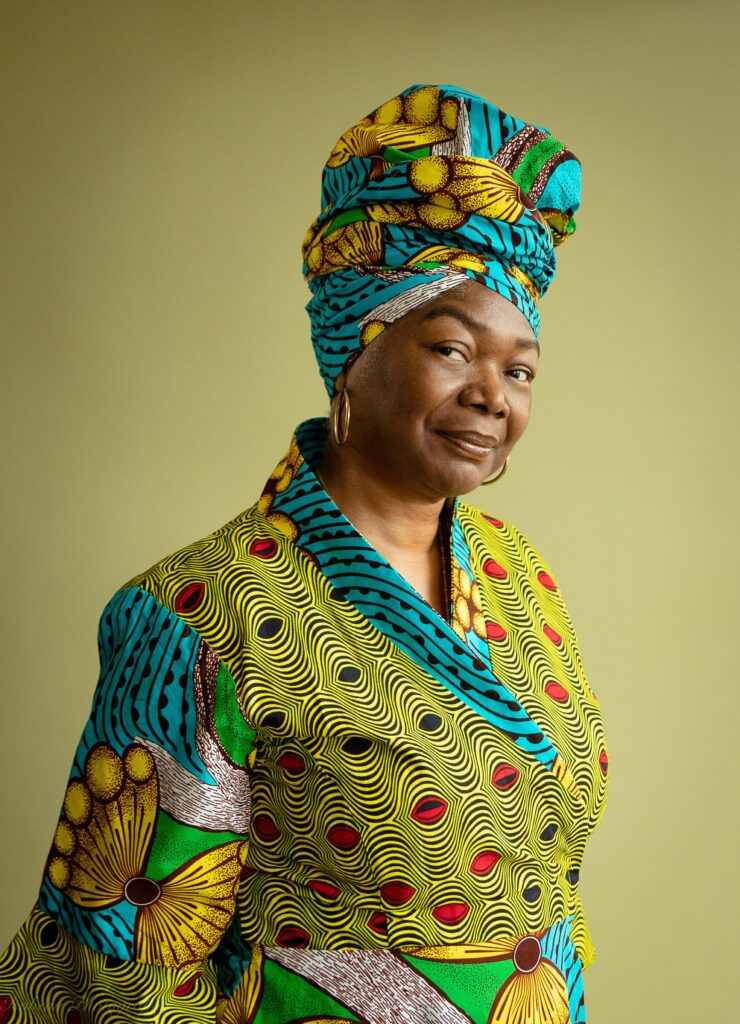
By Rosita Rijkland(Akosua Healing)
How the Scramble Came Up for Me
When I saw the African Diaspora short course, I became enthusiastic and also hesitated for a moment. Thoughts from unconscious programs were triggered, such as: I don’t have the academic level to participate in this (I am not good enough) • I will never be able to read so many papers (high school trauma of being forced to read books under pressure)
• Will I be able to follow the lessons in English properly (do I meet the standards)
• Maybe there is someone else who can use it better than I can (not wanting to be the frontrunner)
I absolutely never shy away from challenges to learn and grow, so all the more reason to take this short course.
What I take with me and integrate into my life and work is an important quote that Dr. Adwoa Owusuaa Bobie shared about history at the start of the course: “It’s all about perspective.” And nothing could be more true!
The different papers, the questions and discussions about them in class, have truly lifted a corner of the veil on how many layers coming from many different perspectives there are. “The
scramble” and “keeping up appearances” has made clear how the system is more than an economic and political game of great magnitude.
Therefore, I refurbished the African proverb to, “Every story will glorify the hunter, until the lion starts to write.” Because the Lion did not need to learn how to write, it already could, not getting the chance because it was being hunted! This course made painfully clear how deeply Africa has been “scrambled” by the greed of Eurocentric perceptions that wanted to force a linear
world view and this still deeply affects our lives today.
What I already knew but became more clear for me is that history is not something that happened in the past—it is something that lives in our bodies, our nervous systems, our
relationship with life, with money, and our capacity to believe in ourselves. The scramble for Africa that took place in the late 19th century did not end with independence movements. The
scramble continues—in the fragmented sense of self that also I myself have experienced and many of my clients carry, in the survival mechanisms that keep us hypervigilant, in the economic
systems that still extract value from Black bodies and Black lands.
As a trauma release facilitator working primarily with descendants of the African diaspora, I am witnessing now more than ever before, how colonial violence reverberates through generations.
But this course gave me language, context, and a deepened understanding of what I see every day in my practice. It confirmed and underlined to me the importance of why the tools of healing
must be as multidimensional as the trauma itself. And it ignited in me not only the fierce commitment to my work, but also, to read more Black writers and dive more into the stories
behind the stories we did not know about, to guide my clients toward deeper ancestral reconnection. And what prompted me also to understand the Black woman’s body—my body,
my clients’ bodies—as an archive that holds stories the world tried to erase.
This reflection explores four interconnected themes that emerged from my engagement with this course: the power of narrative and who gets to tell the story, the reality that trauma lives in the
nervous system and requires somatic(aligned to black people) and spiritual healing, the economic dimensions of colonial trauma and their impact on self-worth, and finally, the Black
woman’s body as a site where all these themes converge.
Theme 1: Who Tells the Story?
This course made painfully clear how deeply Africa has been “scrambled”. The narratives we inherited were shaped by the hunter, not by those who were hunted.
This matters profoundly for healing work. When someone comes to me carrying shame about their ancestry, carrying the belief that their people were passive victims, carrying the internalized
message that Blackness equals inferiority, and therefore turn their back on themselves—they are carrying the hunter’s story. And from the broader perspective that I now have, I can let them
know that our ancestors resisted, that anti-colonial consciousness existed long before it was allowed to be written down, that there were complex civilizations, trade routes, spiritual systems,
and ways of knowing that pre-dated European contact.
Therefore this course gave me the powerful insights and the understanding how much our ancestors fought back. There were many revolts and resistance was there. The consciousness
was there. But the colonizers tried to suppress it, to write it out of history. When my clients begin to learn these truths—when they get more interested to dive deeper and read from Chinua
Achebe, Ama Ata Aidoo, when they encounter many more African, but also Surinam diaspora writers like Anton de Kom, who tell our stories from our perspective—something shifts. It is not
just intellectual knowledge. But it is a reclamation of narrative power.
In my practice, I not only guide my clients through the process of the release of ancestral trauma, but also guide them to ancestral healing and reconnection. This is not metaphorical
work. When someone connects with their lineage, they often encounter stories that were silenced—stories of strength, of wisdom, of survival against impossible odds. These stories
begin to transmute the shame. The narrative shifts from “my people were broken” to “my people survived the unsurvivable.” This shift is foundational for all levels of healing.
Knowing now how Africa is writing her own stories from an African perspective, is a strong and important healing practice. For those of us in the diaspora, reading these stories, centering
these voices, is not optional. It is medicine!
Theme 2: The Nervous System Remembers
A very significant breakthrough in trauma research over the past few decades is to comprehend that trauma is not just a psychological experience—it lives in the body. The nervous system
remembers what the mind tries to forget. And when we talk about intergenerational trauma, we are talking about nervous systems that have been shaped by centuries of threat, violence, and
dehumanization.
The scramble for Africa was not just a political and economic event. It was a neurological event.
Everywhere Europeans went, they created a massive change in dynamics. They left a trail of destruction, and the effects remain profound. The nervous systems of entire populations were
forced into chronic survival mode—hypervigilance, dissociation, shutdown. These adaptations were necessary for survival. But they were passed down. Epigenetics shows us that trauma can
be transmitted through generations, not just through stories but through the very biology of stress response.
Like the many layers of perspective, we also need to see how this shows up for all of us in life.
What I see in my practice, again and again, are clients who are stuck in survival mode. They work hard, they achieve, they push—but they cannot rest. They cannot trust. They struggle to
believe in their own worth, their own capacity, their own right to take up space. This is not a character flaw. This is a nervous system that has been shaped by a history of being told, in
more than a thousand ways, that Black bodies are not safe, not valued, not sovereign.
Healing from this requires more than positive thinking. It requires a nervous system reset individually and collectively. It requires so many more things, like somatic practices (for Black
people) that help the body learn that it is safe, that it can move from survival to thriving, from hypervigilance to presence. In my work, I use my own authentic approach and also integrate
modalities that address different layers, like breathwork, movement, ritual, energy work— because the mind alone cannot undo what has been encoded in the tissues and cellular
memory.
But here is what this course reminded me: anti-colonial consciousness was always there. Our ancestors were not passive. They resisted, stayed true to the truth they felt deep inside their
core. They retained their spiritual practices although in secrecy, their languages, their ways of knowing, even under brutal repression. That resistance lives in us too. The nervous system may
carry the trauma, but it also carries the resilience. Part of my work is helping clients access that resilience—not as something they have to create from scratch, but as something they inherit,
something that is already there, waiting to be uncovered and remembered.The shift from survival mode to sovereignty is not just psychological. It is spiritual. It is ancestral.
It is a return to something that colonization tried to destroy but could not.
Theme 3: Economic Trauma & Self-Worth
One other theme that struck me powerfully in this course was the blunt reality that slavery was driven by economic interests. This is not news, but the depth of it—how cowry shells became
currency for the slave trade in the Maldives, how apprenticeship systems were used to continue exploitation after formal abolition, how extraction of resources continues to this day in the form
of neocolonial economic policies—this painted a picture of a global system built on the commodification of Black bodies and Black labor.
This system is still very active and alive. The structures have shifted, but the extraction continues. Wherever the Dutch colonized, for example, those countries are still struggling. The
wealth was taken, and it never came back. The economic trauma is ongoing and very visible in the lives of descendants.
I have experienced and see in my practice how this manifest in deeply personal ways. The relationship with money is almost always fraught for my clients. There is a push-pull dynamic: a
drive to achieve financial security (because survival depends on it) paired with a deep discomfort around wealth, around charging what one is worth, around receiving abundance.
There is often a belief—sometimes conscious, sometimes unconscious—that “people like us” don’t get to have financial ease.
This is economic trauma. It is the internalization of a system that has said, for centuries, “your labor belongs to us, your body is a commodity, your value is determined by your usefulness to
those in power.” Even when we are no longer enslaved, even when we are free to build businesses, to earn, to accumulate—the nervous system still carries that message. The
relationship with money becomes a reflection of the relationship with self-worth.
Healing this requires more than financial literacy. It requires addressing the root belief: “Am I worthy of abundance? Am I allowed to rest? Can I receive it without having to prove my value
through endless labor?” These are spiritual questions as much as economic ones.
Pan-Africanism, in its truest sense, offers a framework for thinking about this collectively. I myself never knew of the difference in meaning of pan-Africanism with a small ‘p’ and Pan-
Africanism with a capital ‘P’, this is significant to know for the collective. The latter envisions not just cultural solidarity but political and economic unity—a recognition that the diaspora’s healing is tied to Africa’s healing, and that both require economic justice. We cannot heal individually if the systems that exploit us remain intact. The work is both personal and structural.
I now have a better understanding of the meaning behind the word “Diaspora”. It is really a process and a formation of new ethnic communities that will continue to reshape the political,
cultural and economic landscape. Clearly now increasingly getting invested with new possibilities for a globalized future.
Theme 4: The Black Woman’s Body as Archive
After this course ended, I found myself drawn deeper into a specific area of inquiry. The themes I had been exploring—narrative erasure, nervous system trauma, economic exploitation—all
converged in one site: the Black woman’s body.
I sought out essays that addressed this directly. I found “Het slaafgemaakte Lichaam,” which examines the paradox of the Surinamese apartheid system in the 19th century, and “The Stain
of Slavery on the Black Woman’s Body and the Development of Gynecology” by Maia A. Hill in the Mackey Journal. Both texts illuminated something I had felt but had not fully articulated: the
Black woman’s body was the site of the deepest violence, the most intimate exploitation, and the most profound erasure.
This is not abstract for me. I am a Black woman who also has indigenous Kaliniã roots. My ancestral line runs through Suriname, through systems of enslavement and apartheid, through
generations of women whose bodies were not their own.
Reading these essays, I felt my own body respond. It was not just intellectual engagement. It was a calling from my lineage, a
recognition that this history lives in me, in my cells, in the ways I have had to learn to trust my own body after lifetimes of it being seen as something to be controlled, used, studied, violated.
The development of modern gynecology is inseparable from the torture of enslaved Black women. J. Marion Sims, often called the “father of gynecology,” performed experimental
surgeries on enslaved women without anesthesia. Their pain was considered irrelevant. Their bodies were laboratories. This is not distant history. The medical system still carries the legacy
of viewing Black women’s bodies with suspicion, with disregard, with a lack of care. Black women today are more likely to die in childbirth, more likely to have their pain dismissed, more
likely to be subjected to unwanted medical interventions.
In my practice, almost all of my clients are Black women. And I see this history in their bodies. I see the dissociation, the difficulty trusting their own sensations, the internalized message that
their pain does not matter. I see the hypervigilance around being seen, being touched, being vulnerable. I see the ways they have learned to armor themselves, because the world taught
them that their bodies are not safe.
Healing this requires a different kind of witnessing. It requires creating spaces where Black women can feel their bodies again, where they can reclaim sensation, pleasure, sovereignty. It
requires rituals that honor the body as sacred, as wise, as a site of power rather than violation. It requires reconnecting with ancestral practices—African spiritual traditions, indigenous healing
modalities—that see the body as interconnected with spirit, with land, with lineage.
The essays I found after this course gave me a deeper understanding of what I am working with. The Black woman’s body is an archive. It holds the stories that were never allowed to be
told. And part of my work is creating the conditions for those stories to emerge, to be witnessed, to be honored, to be acknowledged so healing can finally begin to take place.
Conclusion: Writing Our Way Forward
This course did not just teach me about the African diaspora. It taught me about my own work, about why I do what I do, and about what is required for true healing. The scramble for Africa
continues in our nervous systems, in our economic realities, in our relationships with each other and with our own bodies. But the resistance continues too. The capacity for healing, for
reclamation, for sovereignty—it was never destroyed. It is still here.
One of the commitments I am taking forward from this course is to read more Black writers, and to encourage my clients to do the same. Reading our own stories, written from our own
perspectives, is a healing practice. It is a way of reclaiming narrative power, of learning the truths that were hidden, of connecting with the resilience that was always there.
Another commitment is to continue to deepen my work with ancestral reconnection. The ancestors fought. They resisted. They survived. And they have wisdom to offer us now, if we are
willing to listen. Creating space for that reconnection—through ritual, through ceremony, through intentional practice—is some of the most powerful healing work I know. And feel deeply honored for being trusted with my ability to hold space for this work.
And finally, I am committed to honoring the Black woman’s body as an archive, as a site of profound resilience, as sacred. The violence that was done to our bodies does not define us.
But it must be acknowledged. It must be witnessed. And it must be healed—not just individually, but collectively.
Africa has the potential to rise, if it can navigate the crises it faces. The diaspora has the potential to heal, if we can reconnect with our roots, reclaim our stories, and build systems that
reflect our worth. The work is both intimate and vast. It is personal and political. It is spiritual and material.
The lion is fiercely writing, it will take more generations, we need all hands, minds and hearts on deck and an evolving consciousness to globally make a shift . But I do strongly believe we are
finding our way home. You cannot fool the heart that is shaped by generations of knowing.
References
Hill, M. A. (2020). The Stain of Slavery on the Black Women’s Body and the Development Gynecology: Historical Trauma of a Black Women’s Body. The Macksey Journal, 1, Article
21782. https://mackseyjournal.scholasticahq.com/article/21782-the-stain-of-slavery-on-theblack-women-s-body-and-the-development-gynecology-historical-trauma-of-a-black-women-sbody
Van Stipriaan, A. (2015). Het slaafgemaakte Lichaam: Paradox van het Surinaamse apartheidssysteem in de negentiende eeuw. De Moderne Tijd, 34. https://demodernetijd.